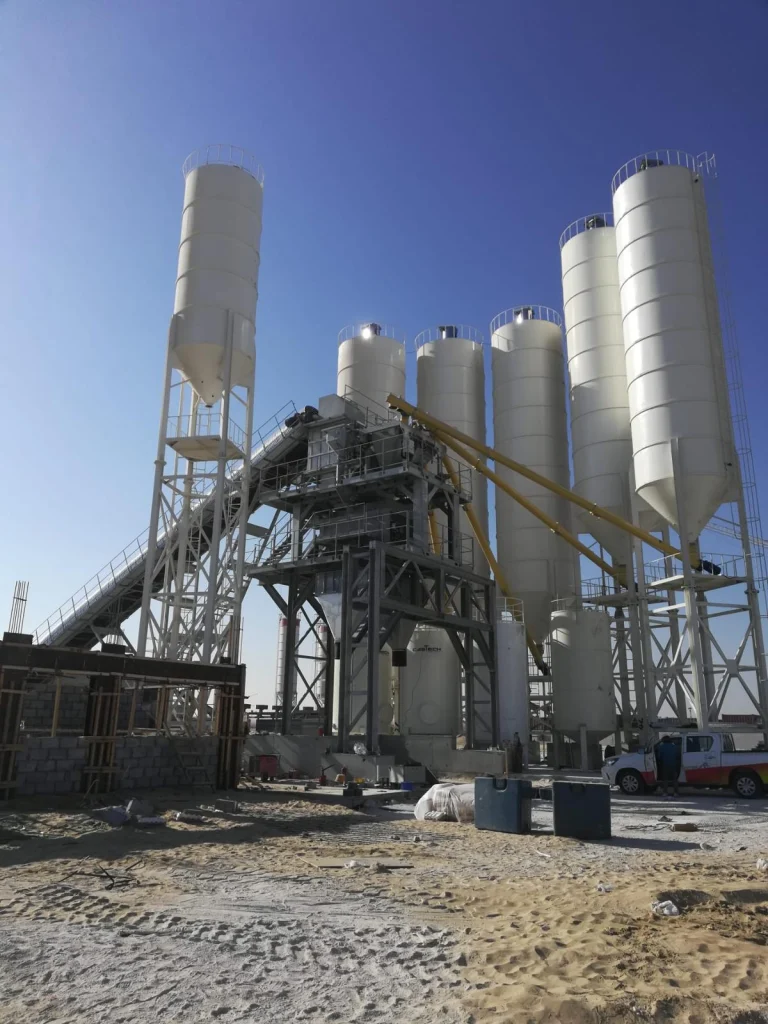
A concrete batching plant weighs aggregates (sand and gravel), cement, water and admixtures according to a mix design and blends them into ready-mix concrete of a specified class. Ready-mix suppliers, precast manufacturers, infrastructure projects such as roads and dams, and large construction sites use batching plants to produce concrete on demand, in a controlled and continuous way.
Main components of a concrete batching plant
- Aggregate bins: different aggregate sizes are stored in separate compartments and dosed onto the weighing belt through gates.
- Weighing systems: aggregates, cement, water and admixtures are weighed separately on load cells. Concrete quality depends heavily on weighing accuracy.
- Conveying: weighed aggregates are carried to the mixer by an inclined belt conveyor or a skip hoist.
- Cement silos and screw conveyors: cement and fly ash are stored in silos protected from moisture and fed to the scale by screw conveyors.
- Mixer: the heart of the plant. Twin-shaft and planetary mixers are the most common types.
- Control cabin and automation: recipes, dosing, mixing time and production records are managed by the automation system.
How does a batching plant work?
- The operator selects the recipe for the required concrete class and the quantity on the control screen.
- Aggregates, cement, water and admixtures are weighed on their own scales.
- The materials are discharged into the mixer in a set sequence and mixed for the specified time.
- Homogeneous concrete is discharged into a truck mixer or concrete pump.
- While one batch is mixing, the next one is being weighed, which allows the plant to reach its hourly capacity.
Types of concrete batching plants
Mobile concrete batching plants are mounted on a chassis, set up quickly and moved from site to site. Compact plants combine bins, weighing and mixer in a small footprint. Stationary plants are built for high, continuous output at ready-mix and precast facilities. In dry batch plants, materials are mixed in the truck mixer instead of a plant mixer.
How is capacity expressed?
Plant capacity is usually given in m³/h. This is a theoretical value; real output depends on the number of truck mixers, aggregate feeding speed and the mix design. To choose the right capacity, consider both your daily volume and your peak-hour demand. See our capacity calculation guide for worked examples.
Not sure which plant suits your project? Read our guide on mobile vs stationary plants or contact us for a free quote.
Let's choose the right plant for your project
Get a free quote for a concrete batching or crushing plant that fits your capacity, site and budget.